Monday, March 9, 2009

Afghanistan...a defense of history

Its sad what passes for op-ed's these days in Canada's largest newspaper The Toronto Star. Last week's article highlights everything that is wrong with people who not only ignore history but are defiant in the face of what lessons it can teach us about occupation, insurgency and exporting democracy.

Canada has over 2000 troops in Afghanistan, one of the largest contingents after the United States. President Obama has pledged more troops to the region as focus shifts away from Iraq to Afghanistan, in recognition that things are getting worse for the current expeditionary force in the region and Afghan citizens.

4 Canadian soldiers have been killed in Afghanistan in the past week. Over 100 troops out of a force of just over 2000. This map highlights the home town's of each fallen soldier. An almost %5 death rate, which would translate to approximately 15,000 dead American soldiers in Iraq. There are many forces at play in the current Afghan conflict. For Canadians there is a constant need to temper analysis with homage and respect for the soldiers in the field, but we do them a disservice when we choose to portray our mission in grand terms which generations of Afghans have heard before from different colonial masters. And generations have not only fought back against Western nation's so-called "good judgment" of how the region should be governed, they have been successful in deterring the worlds largest armies.

Yes of course Canada is not Russia. Yes our soldiers do not treat entire populations like the Russians did and continue to do in other Caucus states. But for many there is little difference among uniforms, invaders are invaders. To ignore this fact, and to whitewash our mission as a unique almost divinely sanctioned act is to be the biggest fool of all.


Afghan past wars not a harbinger

March 06, 2009
Rosie DiManno
http://www.thestar.ca/


Whenever I hear or, more frequently, see published the lament "Has history taught us nothing about Afghanistan?" in relation to foreign intervention there, I know instinctively that the speaker or writer has precious little knowledge about Afghanistan.
(your instincts are that sharp that the mere suggestion that history could teach us something allow you to rush to judgment? J)

They've never read the history texts, the military archives, the memoirs or the poetry. They've probably never been there.
(i dont have to go back in time to the 18th century to study the French Revolution or consider how the collapse of a state from within could be replicated in modern times. There are many who have traveled and lived in Afghanistan who hold contrary and varied views from the North American mainstream, they are not granted full authority because of their passports. J)

It is found wisdom, most likely a repetition of superficial commentary digested from elsewhere, a circular axiom that invests in the ill-informed a phony patina of insight. More disapprovingly: "Did we learn nothing from the Russians?

(a circular axion...a phony patina of insight?... great grouping of words that tell us nothing other than the presupposition that people who refer to Afghanistan's history of foreign occupation not only lack insight but have probably never traveled to the region.... quite a leap of intellectual faith. J)

Or, to quote our own prime minister: "We are not ever going to defeat the insurgency. My reading of Afghanistan's history is that they've probably had an insurgency forever, of some kind." Stephen Harper may have a big brain for economics – that's debatable – but he's talking through his hat here. More likely, because he's singularly lacking in communication skills, Harper was attempting to make contextual observations about the Afghan dilemma and sank under the weight of his own leaden language.

A further 17,000 US troops are on their way, dispatched by Obama. Despite the torque in some quarters by those who claim Obama is going to shift the focus by emphasizing diplomacy and reconstruction, combat troops don't do détente.


As Americans discovered in Iraq, nothing can be done to smother an insurgency without first protecting the populace and then making allies with regional militias.
(A sad over-generalization, they fought regional militias for year and still are in many respects, its a blanketed statment to suggest you cannot defeat insurgency unless you protect the populace make allies with local fighters. Each situation calls for a different approach. The line between "populace" and "regional militias" is often a grey one, making the writer's prescription all the more untenable, and ill-informed. J)
Afghanistan isn't Iraq, or Vietnam for that matter. There is no nation-wide, grassroots guerrilla war. Even with the Taliban now at its most powerful since its 2001 ouster, on-the-ground polling shows they have only 10-15 per cent support among Afghans – and zero among Uzbeks, Tajiks, Hazaras, Turkoman or any other Afghan ethnic group beyond the Pashtun.
(On the ground polling? is Ipsos-Reid conducting polls in Kandahar and Kabul? No source is provided for these polls, and it is difficult to expect open and honest answers from Afghans if we dont know the circumstances of the polls. Even if we accept the %10-15 amount, we neglect to appreciate how few people are required to initiate and maintain an insurgency in a state like Afghanistan with a sparse population base outside of Kabul and weak infrastructure.

If %10-15 support the Taliban, they are quite effective thus far in battling the International Security Assitance Force or ISAF in the region. More troops are being promised by member states because as it stands the mission has not succeded in stabilizing the country. Be it by account of more troop deaths, lack of democratic progress or development and ongoing strife in the border region with Pakistan we have nothing but propaganda that tells us "all is well" simply because Canadian boots are on the ground bringing democracy. BS. J)
It is far from a lost cause, except among the defeatists, entrenched isolationists and jihadist sympathizers. More crucially, the NATO mission – about to have its chestnuts pulled from the fire by the U.S. cavalry – is not remotely similar to what the Soviets attempted in the '80s.

In support of a teetering Afghan Communist government – and these were made-in-Afghanistan Marxists, who'd unleashed revolution against religious fundamentalists in the early 1950s – Moscow went in with gunships blazing. Where the indigenous Communists had already plunged Afghans into social upheaval – instituting land and marriage reforms, liberalizing attitudes toward women, removing dedications to Allah from government statements and replacing Islamist green with socialist red in the Afghan flag – the Soviet occupiers were even more ruthless and terrorizing.

Their helicopters pounded villages. They used chemical poisons in the form of short-duration gas bombs, littered the land with butterfly bombs – often camouflaged as children's toys and designed to maim rather than kill, a far more disruptive outcome for guerrilla forces on the move – and anti-personnel mines dropped from aircraft. They killed livestock, ruined wells, blew up mosques.

The mujahideen favoured sabotage operations. The more common types of sabotage included damaging power lines, knocking out pipelines and radio stations, blowing up government office buildings, air terminals, hotels, cinemas, and so on. From 1985 through 1987, an average of over 600 "terrorist acts" a year were recorded. In the border region with Pakistan, the mujahideen would often launch 800 rockets per day. Between April 1985 and January 1987, they carried out over 23,500 shelling attacks on government targets. The mujahideen surveyed firing positions that they normally located near villages within the range of Soviet artillery posts, putting the villagers in danger of death from Soviet retaliation. The mujahideen used land mines heavily. Often, they would enlist the services of the local inhabitants, even children.

(Yes the Russians did do this, but their enemies, the mujaheddin were known for large-scale destruction of civilian and military targets, including bridges, major roads, attacking convoys, disrupting the electric power system and industrial production. On September 4, 1985, insurgents shot down a domestic Bakhtar Airlines plane as it took off from Kandahar airport, killing all 52 people aboard. Lets not engage in military dick-swinging when discussing the Russian-Afghan war. J)

Worst of all, for deeply religious Afghans, they tried to impose godlessness on a nation that lives and breathes Islam. That, more than anything else, bound Afghans together in the ultimately successful mujahidin resistance: It was their collective duty to fight the kafirs.

NATO troops have done none of this, at least not by design, and neither will the incoming Americans. Every armed outsider bends over backwards to accommodate religion and tradition and consultation with elders. Arguably, NATO has been too respectful and self-restraining as the Taliban reconstituted under its watch.
( I am dumbfounded at the revisionist ramblings of the Russian-Afghan conflict presented as fact before the conclusion that NATO and other member states havent done anything similar and have given no reason for the populace to fight back against their occupation. The audacity to somehow qualify the rebellion against Russia as "the collective duty to fight kafirs" and assume this very same logic wouldnt be applied to any and all invading forces, because thats exaclty what many who took up arms against "kafirs" see the current NATO invasion as. J)

There is no aim to destroy Afghanistan in order to reinvent it in whatever dim echo of democracy, Islamic-style, the citizenry favors. The vast majority of Afghans understand this. Too many Canadians don't.
-------------------------------------------------------------

In reality that is exactly what the current mission in Afghanistan is meant to do; dismantling the remnants of the Taliban government, install a President (a former chief of an American-based energy company operating in Central Asia at the time) who only "won" an election by way of voting in the only remotely secure region in the nation: Kabul. Sadly the majority of soldiers being killed or injured are occurring outside the city, in regions less sympathetic to their hand-picked leader.

I find it ironic that this article begins with a generalization about anyone who suggests we attempt to learn something from history and proceeds to end their story with a larger generalization about what "the vast majority or Afghans" understand. To suggest we or any other nation knows what the majority of Afghan's understand is no different from the Russians, decades ago who believed communism and Russian rule was best for the region.

Too many Canadians probably have a better idea that this author is willing to ascribe to them. Not only are historians accused of misunderstanding the Afghan war, so are most "too many" Canadians. Only Rosie Dimanno and those who agree with her narrow and ill-informed world-view seem to know and have proceeded to tell us.

Its a sad day when we turn our backs on history and drink our own state-sponsored kool-aid on why our troops are deployed in a nation that never attacked Canada, that has never posed an identifiable threat to our nation, only elements that operated within its borders, and continues to show signs of defiance after 7 plus years and over 110 dead Canadians to show for our efforts.

What exactly do we intend to do other than pour in more troops in the region?

Even Wikipedia gives us a glimpse of whats to come... or what has already started:

In a 1998 interview with Le Nouvel Observateur, Brzezinski recalled: "We didn't push the Russians to intervene, but we knowingly increased the probability that they would...That secret operation (to support the mujaheddin) was an excellent idea. It had the effect of drawing the Soviets into the Afghan trap...The day that the Soviets officially crossed the border, I wrote to President Carter. We now have the opportunity of giving to the Soviet Union its Vietnam War."
March 1980-April 1985: Soviet offensives

The war now developed into a new pattern: the Soviets occupied the cities and main axes of communication, while the mujaheddin, divided into small groups, waged a guerrilla war. Almost 80 percent of the country escaped government control. Soviet troops were deployed in strategic areas in the northeast, especially along the road from Termez to Kabul. In the west, a strong Soviet presence was maintained to counter Iranian influence. Conversely, some regions such as Nuristan and Hazarajat were virtually untouched by the fighting, and lived in almost complete independence.


Mark Twain once said "history does not repeat itself, it rhymes".

J


Tuesday, March 3, 2009

Mexico in Crisis


Mexico is facing a crisis that could potentially topple its government within the year.


Lets examine the facts, and consider how regional instability can easily bleed into to the more stable tourist and mining regions of this fragile state.


Some background of the source of Mexican Instability from Wikipedia:

The Gulf Cartel (Cártel del Golfo) is a Mexican drug trafficking organization. The Gulf Cartel traffics cocaine, marijuana, methamphetamine and heroin across the border to major cities in the United States. The group is known for its violent methods and intimidation, and works closely with corrupt law officials and business people in Mexico as well as in the United States. The sphere of influence for the cartel has been determined to be from the Gulf Coast state of Tamaulipas to Piedras Negras, Coahuila.

The Gulf cartel does not limit itself solely to narcotics trafficking, as they have been known to kidnap local businessmen to collect money.

Once a radical fringe group Los Zetas headed by Heriberto Lazcano provide the muscle for the Gulf Cartel. Los Zetas are at the forefront of the recent spate of violence occuring primarily on the border regions with the United States.


The Zetas is the first criminal organization in the Americas to have been formed by former military personnel and defectors from a regular army. Mexico's General Attorney classified and filed the Zetas as an armed division of the Gulf Cartel in December 1996.

The Zetas represent a major threat to Mexico's national security. Organised crime was designated a national security threat in 1987, and the Zetas are now one of the major criminal groups operating in the country. As army defectors, the Zetas possess considerable military expertise, training and experience in combat, guerrilla and urban warfare.

The Zetas' formation represented the first time that a drug cartel possessed such a sophisticated and well-trained armed division. Since then they have been responsible for the cartel's security, logistics, assassination of its rivals and its ambitious expansion strategy to other territories that are under the control of rival drug syndicates.

The Wall Street Jounal's Joel Kurtzman characterizes the current spate of violence as potentially disruptive to whats left of any democratic institutions in Mexico:

Mexico's Instability Is a Real Problem

Don't discount the possibility of a failed state next door.

Mexico is now in the midst of a vicious drug war. Police officers are being bribed and, especially near the United States border, gunned down. Kidnappings and extortion are common place. And, most alarming of all, a new Pentagon study concludes that Mexico is at risk of becoming a failed state. Defense planners liken the situation to that of Pakistan, where wholesale collapse of civil government is possible.

One center of the violence is Tijuana, where last year more than 600 people were killed in drug violence. Many were shot with assault rifles in the streets and left there to die. Some were killed in dance clubs in front of witnesses too scared to talk.

It may only be a matter of time before the drug war spills across the border and into the U.S. To meet that threat, Michael Chertoff, the outgoing secretary for Homeland Security, recently announced that the U.S. has a plan to "surge" civilian and possibly military law-enforcement personnel to the border should that be necessary.

The problem is that in Mexico's latest eruption of violence, it's difficult to tell the good guys from the bad. Mexico's antidrug czar, Noe Ramirez Mandujano was recently charged with accepting $450,000 from drug lords he was supposed to be hunting down. This was the second time in recent years that one of Mexico's antidrug chiefs was arrested for taking possible payoffs from drug kingpins. Suspicions that police chiefs, mayors and members of the military are also on the take are rampant.

In the past, the way Mexico dealt with corruption was with eyes wide shut. Everyone knew a large number of government officials were taking bribes, but no one did anything about it. Transparency commissioners were set up, but given no teeth.

And Mexico's drug traffickers used the lax law enforcement their bribes bought them to grow into highly organized gangs. Once organized, they have been able to fill a vacuum in underworld power created by Colombian President Álvaro Uribe's successful crackdown on his country's drug cartels.

The result is that drug traffickers are getting rich, while Mexico pays a heavy price in lost human lives and in economic activity that might otherwise bring a modicum of prosperity to the country.

To his credit, Mexico's President Felipe Calderón has deployed 45,000 members of his military and 5,000 federal police to fight drug traffickers. This suggests that he is taking the violence and the threat to civil government seriously.

(Deploying 45,000 troops, the equivalent of 3 army divisions, or an entire corps of a possible 230,000 army soldiers suggests Mexico's President is scared out of his mind that things might escalate and topple his tenuous hold on power. J )

But the path forward will be a difficult one. Not only must Mexico fight its drug lords, it must do so while putting its institutional house in order. That means firing government employees who are either corrupt or not willing to do the job required to root out corruption. It will also likely require putting hundreds, or even thousands, of police officers in jail.

For more than a century, Mexico and the U.S. have enjoyed friendly relations and some degree of economic integration. But if Mexico's epidemic of violence continues, that relationship could end if the U.S. is forced to surge personnel to the border.


As traders an investors in precious metals exploration, we need to look well beyond the PR work of mining firms who never tire of painting a rosy picture of geopolitical tensions. Consider what has happened to mining projects in other Latin American states where democratically elected regimes have taken charge such as Bolivia's Evo Morales. Dont expect any of the booths at Toronto's PDAC to give you a straight answer on the growing instability of Mexico.

Here is a not so brief list from Mineweb of mining companies from Canada with current projects in Mexico:

Alamos Gold (Toronto): Sonora
Aquiline Resources (Vancouver): Sonora
Aurcana Corporation (Vancouver): Queretaro
Avino Silver and Gold Mines Ltd. (Vancouver): Durango
Baja Mining Corp. (Vancouver): Baja Peninsula
Bralorne Gold Mines Ltd. (Vancouver): Durango
Canasil (Vancouver): Durango, Sinaloa, Zacatecas
Canplats Resources Corporation (Vancouver): Durango, Chihuahua
Capstone Gold Corp. (Vancouver): Zacatecas
Cardero Resource Group (Vancouver): Baja California,
CDG Investments Inc. (Calgary): Sinaloa
Chesapeake (Vancouver): Oaxaca, Sonora, Durango, Sinaloa, Chihuahua
Columbia Metals Corporation Ltd. (Toronto): Sonora
Comaplex Minerals Corp. (Calgary): Mexico State
Coniagas Resources (Toronto): Zacatecas
Continuum Resources Ltd. (Vancouver): Oaxaca
Copper Ridge Explorations Inc. (Vancouver): Sonora
Corex Gold Corporation (Vancouver): Zacatecas
Cream Minerals Ltd. (Vancouver): Nayarit
Diadem Resources (Toronto): Zacatecas
ECU Silver Mining (Rouyn-Noranda): Durango
Endeavour Silver (Vancouver): Durango
Energold Drilling Corp [Impact Silver Corp.] (Vancouver): Mexico State
Evolving Gold Corp. (Vancouver): currently exploring acquisitions in Mexico
Esperanza Silver Corp. (Vancouver): Morelos
Excellon Resources (Toronto): Durango
Exmin Resources Inc. (Vancouver): Chihuahua
Dundarave Resources Inc. (Vancouver): Chihuahua
Farallon Resources Ltd. [Hunter Dickinson] (Vancouver): Guerrero
Firesteel Resources (Vancouver): Durango
First Majestic Silver Corp. (Vancouver): Jalisco, Coahuila, Durango, Zacatecas
Fording Canadian Coal Trust [NYCO] (Calgary): Sonora
Formation Capital Corporation (Vancouver): Tamaulipas
Fronteer Development Group (Vancouver): Jalisco, Chiapas
Frontera Copper Corporation (Toronto): Sonora
Gammon Lake Resources (Halifax): Chihuahua, Guanajuato
Genco Resources (Vancouver): Mexico State
Goldcorp Inc. (Vancouver): Sinaloa, Durango, Chihuahua, Guerrero, Zacatecas
Gold-Ore Resources Ltd. (Vancouver): Sinaloa
Golden Goliath Resources (Vancouver): Chihuahua
Grandcru Resources (Vancouver): Sinaloa
Grayd Resource Corporation (Vancouver): Sonora
Great Panther Resources Ltd. (Vancouver): Durango, Guanajuato, Chihuahua
Grid Capital Corporation (Vancouver): Chihuahua
Hawkeye Gold and Diamonds (Vancouver): Nayarit
Horseshoe Gold Mining (Vancouver): Oaxaca
Iamgold Corporation (Toronto): (royalties) Chihuahua
Iciena Ventures (Vancouver): Sonora
Impact Silver Corp. (Vancouver): Zacatecas
International Croesus Ltd. (Vancouver): Jalisco
Intrepid Mines (Toronto): Sonora
Kimber Resources (Vancouver): Chihuahua
Linear Gold Corp (Halifax): Chiapas, Oaxaca
Macmillan Gold (Toronto): Durango, Sinaloa, Zacatecas, Jalisco, Nayarit
MAG Silver Corp (Vancouver): Chihuahua, Zacatecas, Durango
Minefinders (Vancouver): Chihuahua, Sonora
Morgain Minerals Inc. (Vancouver): Durango, Sonora
Metallica Resources Inc. (Toronto): San Luis Potosi
Mexoro Minerals Ltd. (Vancouver): Chihuahua
Northair Group (Vancouver): Durango, Sinaloa
Northwestern Mineral Ventures (Toronto): Durango
Oromex Resources (Vancouver): Durango
Orko Silver Corp. (Vancouver): Durango
Pacific Comox Resources (Toronto): Sonora
Palmarejo Silver and Gold (Longueuil): Chihuahua
Pan American Silver (Vancouver): Sonora
Pinnacle Mines Ltd. (Vancouver): Mexico State, Oaxaca
Quaterra (Vancouver): Durango, Zacatecas
Rome Resources Ltd. (Vancouver): Sonora
Ross River Minerals (Vancouver): Sinaloa
Roxwell Gold Mines (Vancouver): Sinaloa
Santoy Resources Ltd. (Vancouver): Sinaloa
Scorpio Mining Corporation (Vancouver): Sinaloa
Silver Crest Mines (Vancouver): Sonora
Silver Standard Resources (Vancouver): Durango, Mexico
Soho Resources Group (Vancouver): Durango
Sonora Gold Corp (Vancouver): Sonora
Sparton Resources (Toronto): Sinaloa, Sonora
Starcore International Ventures (Vancouver): Puebla
Stingray Resources (Toronto): Chihuahua
Southern Silver Exploration (Vancouver): Jalisco, Chihuahua
Stroud Resources (Toronto): Chihuahua
Teck Cominco Ltd. (Vancouver): Guerrero
Terra Novo Gold Corp. (Vancouver): Michoacan
Tumi Resources (Vancouver): Chihuahua, Sonora
Tyler Resources (Calgary): Chihuahua
UC Resources (Vancouver): Durango, Nayarit
Valdez Gold (Toronto): Chihuahua
War Eagle Mining Company (Vancouver): Chihuahua
West Timmins Mining Corp. (Vancouver): Sinaloa, Chihuahua
Zaruma Resources Inc. (Toronto): Sonora


Gold bugs are a strange lot. Forever suspicious of the words of governments, of analysts and mainstream media. Always on guard for the end of fiat money, the end of finance and the end of the world. But too easily swept off their feet by a mining man and a good story.

Dont believe the hype, the Jr. Mining Sector is under duress, the values of far too many Jr. mining outfits represent not great bargains but indications that mining on a small scale has become increasingly expensive and difficult due to global instability in all but a few of the richest mining regions of the world. Not only have Jr. stocks collapsed in price, further erosion has been prevented only by a much higher gold price. Bank stocks would be much higher today if office supplies suddenly exploded in value- it says nothing about the intrinsic ability of these equities to generate any sort of sustainable cash flow.

Good luck, and be careful on your next vacation.

J
aka dr. cosa

Sunday, February 22, 2009

Gold at $1000- then and now

Gold first moved above $1000 in March 2008. The chart below gives us an interesting perspective on gold then and now. Specifically note the arrangement of the simple moving averages (SMA) at the time gold crossed above $1000 in March 2008 and in February of this year.

Too many gold newsletter writers got caught with their pants down predicting the end of the financial world in March 2008, urging readers to get on board and buy gold. The ensuring correction made fools of most of them. As gold moved aggressively above $950 I noticed several gold bug's alerting readers that gold had moved too high too fast and that caution was in order. I think these predictions are self-serving more than anything else. The technical picture is nothing like it was in March 2008 for Gold, and I suspect they will be the first to trumpet their cautionary calls should gold correct down anywhere below $950.

Gold may just crash back down to earth in the event a bank-bailout proposal is viewed as viable by the market, and a perceived stability is entrenched in the public's minds as they abandon safe-haven buying of treasuries and gold. But the alternative is equally troubling for gold bugs: What if all the cautionary tales are just that? Tales. Being stung so often by gold's oxymoronic behavior, are those most vested in gold about to sell the first sign of weakness and miss a much larger advance? Will the oft-predicted explosion in the gold price that catches both shorts and those in cash by surprise come to fruition?

The technical picture is looking better each day fo gold and even the gold shares. But Im suspect of relying soley on TA at this time considering the magnitude of the markets structural problems that we are only topically aware of. What lies beneath multiple levels of bank assets is a mystery to all but the most well studied and informed, and even they seem to be either quiet or confused about the implications.


Contrarians were a popular bunch for some time, and many still profess to be contrarian without realizing the irony inherent to associating one's self with a group that is supposed to move against the herd. Contrarians are becoming a herd unto themselves. Citing examples of gold reaching saturation levels in the media are generally baseless. There have been ads, commentary and discussions of gold for years on both the mainstream and alternative media sites.

The chart below gives what I believe is the best snapshot into the popularity of gold at any given time. Quancast.com provides hit counts for various websites, and Ive posted the daily hit count for the most popular gold site on the web: Kitco.com. Traffic to Kitco has only modestly increased as part of a general uptrend since the end of 2008. This tells me that there is no "gold-fever" per se in the media other than the "cash 4 gold" ads during the Superbowl.


Its always difficult to call considering gold has moved above $900 so quickly. Talk of "momentum" buyers or of "sideline cash" moving to gold have no basis in reality as there is always a seller for every buyer. Momentum studies tell us how the chart is moving but not how long it can continue in any particular direction. Crossover's occur quickly on many indicators and only look prescient in hind-sight. The TA for gold does show it is extended in many ways, but not in others on a comparative basis. Its been 1 year since gold last kissed $1000. It would seem too easy to expect a pull-back from the prior highs simply because they were the prior highs. I also suspect it would be too easy for gold to pull back from here and take a short rest prior to another advance. That is what many expect and that is why I dont believe it will work out as neatly.

Should the US Dollar continue its slide downward that began late last week, golds behavior will give us an illuminating sign of whats to come. Gold has advanced in the face of US Dollar strength for long enough this year to suggest a massive change overhead. Will it advance against US Dollar weakness?

If it does, then
Jim Sinclair's recent prediction may well come true sooner than later:

The third time above $1000 means $1650 and I believe that Alf will take the award for being most correct.

The following is the schedule for Gold:

Gold will try $1060.
Then $1224.
Then $1650.


Its going to be an interesting few months ahead.

Good luck,

J aka dr. cosa


Thursday, February 12, 2009

Dow Theory on Gold

Richard Russell of The Dow Theory Letters on Gold

thanks to 321gold.com for this great contribution from a market veteran and long-time proponent of gold

J

Fear and Greed

Richard Russell
Dow Theory Letters
Feb 12, 2009

February 11, 2009 Gold -- There's only one item that is bought through both fear and greed. That item is gold. Are you worried about the viability of the dollar? Then buy gold -- (fear). Are you afraid that the gold market is getting away from you? Then don't wait -- buy gold (greed).

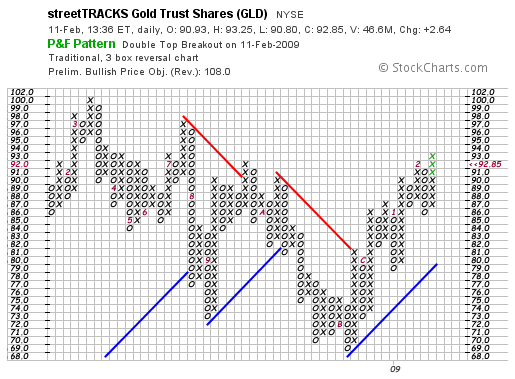
Those subscribers who have heeded my advice -- "buy gold." They are doing OK today. Of course, for years I advocated buying gold coins and hiding them away and never looking at them or thinking of selling those little beauties. Now if you want gold, you have to buy "paper gold" in the form of GLD. Which is probably OK. Below we see an up-dated chart of GLD. And we see the breakout today at 92.29. This completes a huge base, which started at the 69 box and since has been building and building.

Note the numerous down-columns, these are the "wipe-outs" which periodically scare people OUT of their gold. Today, with the upside breakout at the 93 box on the P&F chart, we're forced to buy gold in the 944 (April futures) area. For those who missed out on gold when it was in the 700s and 800s, this is a scary proposition. So question -- is it too late to buy GLD or high-premium coins if you can find them?

As I see it, the frenzy, the speculative phase of gold, the rush of a frightened public -- lies ahead. Big bull markets always find a way to keep you frightened and OUT. Big bull markets are devils with no conscience -- to get in you have to "close your eyes, and just do it." Not easy, but in this business nothing is easy except losing money. Which is why I've always loved the gold coins. You buy 'em, you're not tempted to trade 'em, they look great and they feel great. And they're not made of paper, nor can they be created with a computer. Ultimately, "There's no fever like gold fever." And I'm beginning, just beginning, to feel the fever now. When I look at the chart, I can sense the fever rising.

Fiat paper fans and the Fed denigrate gold. They fear gold and despise it. They prefer the Federal Reserve Notes that they can manufacture at will. But as gold rises, they must face the fact that the Notes they manufacture are being devalued. You see, for thousands of years gold has been the standard against which all assets and currencies are measured. When the big bear arrives and everything faces the fire, "gold will be the last man standing, not dollars, not political talk or Presidential promises -- the only survivor will be the eternal and ultimate safe asset -- gold.

Notice the difference in gold trading during the day? Very little profit-taking. Buyers are buying gold to hold rather than to grab intra-day profits.

Richard Russell
website: Dow Theory Letters


Monday, February 9, 2009

Moving Average Study of Gold: simple stuff

I get easily overwhelmed with data points and indicators when looking at charts, in hopes of unlocking a magical method of telling the future.
It doesnt exist, so in the meantime I use good old fashioned moving average studies to take a top-down look at gold and consider what they are telling me. Short term I cant say, I mean everything points to a downward push for a few days or weeks considering how far and how fast gold has risen. But beyond that, looking at the real meat of any potential moves in gold, this chart gives me all I need to feel good about gold's prospects going forward.

enjoy,

J

Friday, February 6, 2009

Gold Trader's Diary


2 current positions:


crude oil position via HOU.TO (crude oil double bull on the TSX):


when can crude oil mount a rally? seems like it wants to move back towards the mid-30's before something can happen. i wonder if too many people believe we've seen the bottom in crude simply because supply/demand fundamentals will cause a decrease in production, which would lead to higher prices...

suppressing the oil price benefits americans the most, and hurts many of america's traditional foes: russia, iran, venezuela. it is no coincidence that any economic stimulus would be all the more effective alongside the massive tax-like cut that is lower oil/gas prices.

its almost too coincidental not to be part of any US administration's plans...

if you are a regional producer of crude oil, relying on it for the majority of your state's income as many OPEC/non-OPEC nations are, you would pump more oil in the case of falling prices to make up for lost revenues. its not so much a supply/demand issues as it is a needs/wants issue. they need money and want it now or the very foundations of many regimes will be toppled.

it worsens the actual situation but empires, nations, communities and individual's have a habit of sacrificing the later for the now. i suspect falling oil prices beget more drops in prices as more supply enters the market. russia, iran, venezuela and other states are crippled by current oil prices.

so will oil find a floor in the 30's simply because producers will stop pumping?

im not sure. they may, but w/ the sheer volume of oil pumped by state-owned oil companies (or shell corporations that are proxies of their oligarchical state-leaders) i find it difficult to envision them cutting off their hands to save their arms because of plain old fashioned short-sightedness.

(the same short-sightedness that got us into this mess in the first place non?)

a great article about Russia's behavior on the global stage with respect to oil and energy can be found at the site of the brilliant William Engdahl titled:
Putin and the Geopolitics of the New Cold War: Or what happens when Cowboys don`t shoot straight like they used to ...

------

gold positions via HGU.TO (gold miners double bull on the TSX)


gold: doing its usual morning crash. ive run out of things to say about gold and gold stocks for the moment. as ive said before there are bullish medium/long term set up's happening on the charts. but TA is like T and A, great to look at and alot of fun, but not a sustainable trait for a bountiful relationship..... their continued under performance vs. gold could be a reality of life going forward, or a sign that gold is unable to really break through its old highs with any real conviction just yet.

the USD is still looking somewhat strong, dont even look at the charts with exponential moving averages because they look dam good, but so does the gold chart. its odd.

im not liking golds action at the moment. but what else is new. i was loving it for some reason just a day or 2 ago, but it truly is a case of 3 steps forward and 2 steps back, sometimes 3 steps back....

HGU is really just UGH!!! in disguise

a great article by the always lucid Steve Saville posted on Kitco gives a thoughtful analysis of the issue on most goldbug's minds: inflation vs. deflation.

(though the question on my mind is: does it really matter?)


The Inflation-Deflation Debate

By Steve Saville
Feb 3 2009 9:17AM

www.speculative-investor.com


For many years we have been expecting inflation (growth in the supply of money) and nothing but inflation as far as the eye can see, but there have been times, such as the past 12 months, when we have felt more affinity with deflation forecasters than with most other inflation forecasters. The reason is that monetary inflation, when measured correctly, was minimal during the first half of 2008 and during the two preceding years, thus setting the stage for a US$ rebound and large price declines in the investments that had been bid up to astronomical heights.

Based on our observation, a lot of confusion on the inflation/deflation issue is caused by the lengthy and variable time delays between changes in the monetary trend and changes in prices. It will often be at least 2 years before the effects of a major change in the monetary trend start to become apparent in the prices of commodities and everyday goods and services. Consequently, during the first 2 years of a new monetary inflation cycle the outward evidence will often point to deflation (even though the inflation threat is rising), and for 2 years following the END of an inflation cycle it will seem as if the inflation threat is growing (even though it is falling).

As outlined below under "Current Situation", a new inflation cycle has almost certainly begun. However, with one notable exception the price-related evidence will probably favour the deflationists until at least 2010. The notable exception is the gold price. As we mentioned in a few commentaries last year, the gold price is the one price that's likely to commence a major upward trend in the early part of a new inflation cycle. The reason is that the gold market is dominated by large speculators who take positions in anticipation of the eventual/inevitable effects of the new monetary trend.

To further explain, the gold market is a very different 'kettle of fish' to other commodity markets. In the gold market the "commercials" are generally clueless because garden-variety commodity supply/demand fundamentals, such as changes in mine supply and industrial/commercial demand, have almost no effect on gold's price trend. Instead, gold's price trend is determined almost totally by investment demand, which is, in turn, driven by the outlook for things such as interest rates, credit spreads, financial asset valuations, money-supply growth, inflation expectations, and exchange rates. Moreover, the people who tend to have the most foresight when it comes to macro-economic phenomena are speculators who have survived and prospered in the financial markets over a long period of time.

In sum, even though the inflation threat has begun to increase the deflationists will probably look right for at least another year. They rarely look right, so we shouldn't begrudge them their relatively brief time in the sun.

Current Situation

We agree with much of the analysis presented by the well-known deflationists. The main point of contention revolves around the ability of the monetary authorities (the Fed and the Treasury in the US) to keep the total supply of money growing. Our view has been, and continues to be, that the Treasury-Fed tag team has the power to promulgate monetary inflation under almost any economic circumstances and will use this power. The bond market could eventually impose a practical limitation on the government's ability to inflate because increasing the money supply becomes counter-productive once the bond market begins to anticipate rapid currency depreciation, but if price-related evidence continues to favour the deflation view over the coming year then this limitation will not arise anytime soon.

The case is not yet closed, but the evidence presented to date supports our view. For example, the monetary base has expanded at an astronomical pace over the past five months. Mike Shedlock has attempted to counter this by pointing out that a sharp increase in the adjusted monetary base (AMB) also occurred during the early 1930s, but the St. Louis Fed's updated long-term chart of the AMB shows that the recent increase has been many times greater than anything during the 1930s. In any case, the overall monetary situation today could hardly be more different to the early 1930s. During the early 1930s the Fed increased the monetary base, but the total supply of money plunged. The current situation is reflected on the following chart, which shows that the year-over-year rate of increase in the True Money Supply (TMS) has reached 10%. Note that TMS does not include bank reserves held at the Fed; it represents money available for spending. The fact is that despite the deflation hysteria there is 10% more money in the US economy today than there was at this time last year.

Steve Saville

-----


good luck gang,


J

Monday, January 26, 2009

Mish uncovers the mask of Peter Schiff

Mike "Mish" Shedlock has one of the best financial blogs around.

His daily posts are informative and succinct.

Today post titled Peter Schiff Was Wrong can be found here. It is by far the most clear-cut case of a over-hyped and over-stuffed analyst high on his own supply. Mish outlines why Peter Schiff despite his leanings towards gold has been on-balance wrong in almost every aspect of his investment philosophy the past year and has yet to revise his thesis.

enjoy.


J